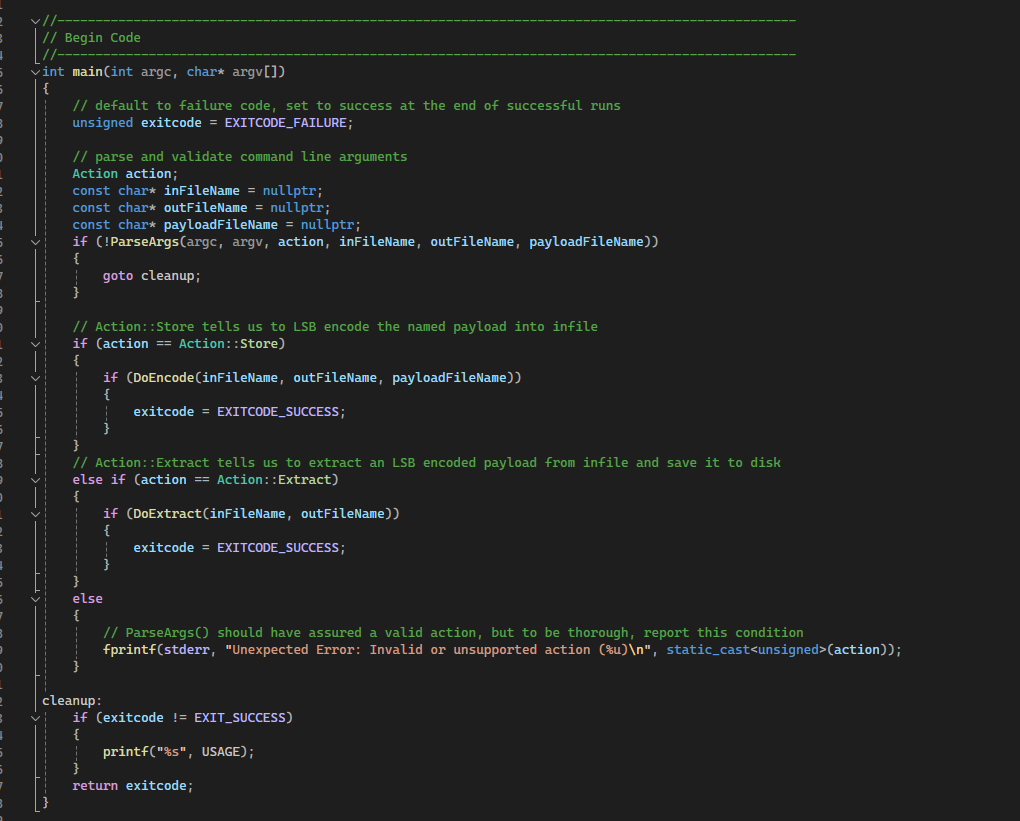
There are standard coding practices to follow in order to make code easier to read, understand, and use.
Good Coding Practices:
Put notes above code to explain what it does
Name functions based on what on it does
Name variables based on its purpose
Use spacing to make code readable
This snippet demonstrates the mentioned coding practices.
Resources:
PDFs for naming and coding practices can be found in Downloads
Book: The Pragmatic Programmer
Topic 2: Strategies for Mastering the Military Decision-Making Process (MDMP) from Joshua
The MDMP can feel overwhelming due to the sheer volume of information, symbology, and interconnected FMs. Applying constant repetition helps, as MDMP is a muscle that benefits from regular cycles.
Actionable Strategies to making MDMP easier:
**Visual Aids and Mapping**
Create mind maps or flowcharts for each step to visualize connections and processes.
Use colors and symbols to categorize tasks (e.g., reconnaissance, logistics) to simplify the mental workload.
**Practical Application**
Run simple, real-world problems (like a road trip) through the MDMP framework to make the concepts feel natural before diving into military complexities.
Participate in exercises, simulations, or Capture The Flag (CTF)-type events to bridge the gap between theory and practice.
**Chunking the Material**
Break MDMP into its individual steps (e.g., mission analysis, COA development) and focus on truly understanding one step at a time.
Prioritize key outputs and their purpose (e.g., the aim of the Mission Analysis Brief)[cite: 22].
**Cross-Referencing Strategically**
Instead of jumping back and forth through Field Manuals (FMs), **build a personal reference guide** by summarizing key points from each FM in your own words. You can find key manuals in our Downloads section.
Use digital tools or bookmarks to tag frequently referenced sections to save time.
**Cycles and Reflection**
After every MDMP iteration, carve out time to **reflect** on what worked, what felt clunky, and what made you pause.
Keep a journal or quick "after-action" cheat sheet to track reflections and fine-tune your process.
**Leverage Peer Support**
Discuss MDMP concepts with colleagues from varied branches or compositions, as their perspective can introduce unique insights.
Explaining concepts to others often leads to a deeper, more personal understanding.
**Mnemonics and Acronyms**
Develop your own shortcuts to remember key symbology or outputs at each stage, creating a personal "language" for faster retrieval.
**Immerse in Real Scenarios**
Deconstruct how successful or failed historical operations utilized MDMP to help drive retention, as the practical stakes help align theoretical knowledge with real-world challenges.